Walk into a decent bar, ask for a whiskey, and you’ll usually get a follow-up question. Scotch or bourbon? Irish? Rye? For anyone who hasn’t spent years reading labels, that moment is mildly embarrassing, and the internet doesn’t help much — half the explanations online treat Scotch and whiskey as rival categories, which is a bit like asking whether you’d prefer a dog or a labrador.
So let’s settle it properly, with the actual legal definitions rather than vague talk about smoke and sweetness.
The short answer
Whisky is the parent category. It’s any spirit distilled from a fermented mash of grain and, with very few exceptions, aged in oak. Scotch is whisky made in Scotland under a specific set of rules. Bourbon is whiskey made in the United States under a different set of rules. Irish whiskey, rye, Japanese whisky and Canadian whisky are all further branches of the same tree.
All Scotch is whisky. All bourbon is whiskey. Neither is a competitor to whisky — both are types of it.
Here’s how the three most-asked-about styles compare at a glance.
| Scotch | Bourbon | Irish whiskey | |
|---|---|---|---|
| Where | Scotland only | United States only | Ireland only |
| Main grain | Malted barley (other cereals allowed in grain and blended Scotch) | At least 51% corn | Malted and unmalted barley, other grains |
| Cask | Oak, up to 700 litres, usually second-hand | New charred oak, always | Oak, usually second-hand |
| Minimum age | 3 years | None (2 years for “straight”) | 3 years |
| Minimum bottling strength | 40% ABV | 40% ABV | 40% ABV |
| Typical character | Malty, fruity, often smoky | Sweet, vanilla-forward, oaky | Light, smooth, gently fruity |
That table answers the question for most people. If you want to know why those differences exist, and why they produce such different liquid, keep reading.
What makes a whisky a whisky in the first place
Strip everything else away and whisky is a simple idea. You take grain, you soak it so the starches convert to fermentable sugar, you add yeast and let it ferment into a rough beer, you distil that beer to concentrate the alcohol and the flavour compounds, and you put the result in oak until it turns from a harsh clear spirit into something worth drinking.
Every whisky on earth follows that sequence. What separates the categories is which grain, what shape of still, what kind of oak, how long, and where. Those variables sound small on paper. In the glass they’re the difference between a Kentucky bourbon that tastes of vanilla and burnt sugar and an Islay malt that tastes like a bonfire on a beach.
The rules matter more than most drinkers realise, because they aren’t marketing conventions. They’re law, and in both Scotland and the United States they’re enforceable. A distillery that ages its spirit in the wrong barrel doesn’t get a slap on the wrist — it loses the right to call the product by its name.
What makes Scotch legally Scotch
The Scotch Whisky Regulations 2009 define the category in detail. In plain terms, a whisky can only be called Scotch if it:
- was distilled at a distillery in Scotland from water and malted barley, with only whole grains of other cereals permitted as additions
- was mashed, converted and fermented entirely at that distillery, using nothing but the grain’s own enzymes and added yeast
- came off the still below 94.8% ABV, so the spirit still carries the character of what it was made from
- was matured only in Scotland, only in oak casks holding no more than 700 litres, for no less than three years
- had nothing added to it except water and plain caramel colouring
- is bottled at a minimum of 40% ABV
Two of those clauses do most of the heavy lifting. The three-year minimum means there is no such thing as young, raw Scotch on a shelf — even the cheapest blend has spent longer in wood than plenty of American whiskey. And the ban on additives means that apart from a touch of caramel for colour consistency, what you taste came from barley, yeast, copper and oak. Nothing is flavoured in afterwards.
The 700-litre cap is quietly important too. It forces a reasonably high ratio of wood surface to liquid, which is why Scotch picks up as much character as it does from casks that have usually already held something else. If you want the full production picture, we’ve covered how Scotch whisky is made step by step.
Within that definition sit five legal categories: single malt, single grain, blended malt, blended grain and blended Scotch. Single malt gets the attention and the high prices, but blends are the vast majority of what Scotland actually sells, and the good ones deserve considerably more respect than they get. The distinction between malt and grain spirit is worth understanding on its own, and we’ve broken down malt whiskey versus grain whiskey separately.
What makes bourbon legally bourbon
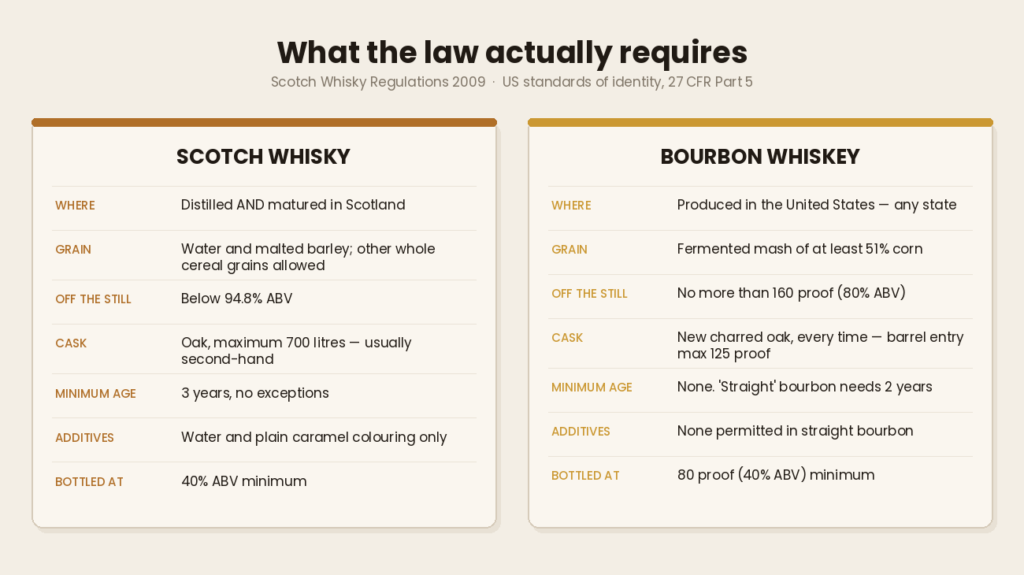
Bourbon’s rules live in the US federal standards of identity, administered by the Alcohol and Tobacco Tax and Trade Bureau under 27 CFR Part 5. To be bourbon, a whiskey must:
- be produced in the United States
- be made from a fermented mash of at least 51% corn
- come off the still at no more than 160 proof (80% ABV)
- go into the barrel at no more than 125 proof (62.5% ABV)
- be aged in new, charred oak containers
- be bottled at no less than 80 proof (40% ABV)
Notice what isn’t on that list. There’s no minimum ageing period for plain bourbon — the two-year requirement applies only to “straight” bourbon, and anything under four years old has to carry an age statement. There’s also nothing about Kentucky. The state makes the overwhelming majority of the world’s bourbon, and it has additional rules of its own for whiskey labelled “Kentucky bourbon”, but bourbon itself is legal to make in any US state.
The clause that shapes bourbon’s flavour more than any other is the new charred oak requirement. Every barrel is fresh. That means every drop of bourbon is pulling flavour from wood that has given nothing away before, which is where the vanilla, caramel, coconut and toasted-sugar notes come from, and why bourbon tends to be sweeter and more obviously oaky than Scotch at the same age. It’s also why bourbon barrels end up in Scotland — the Americans can only use them once, and the Scots are happy to take them second-hand. If you want the fuller story, we’ve written about what bourbon whiskey actually is elsewhere on the site.
Whisky or whiskey? The spelling isn’t random
This trips up more people than the categories do.
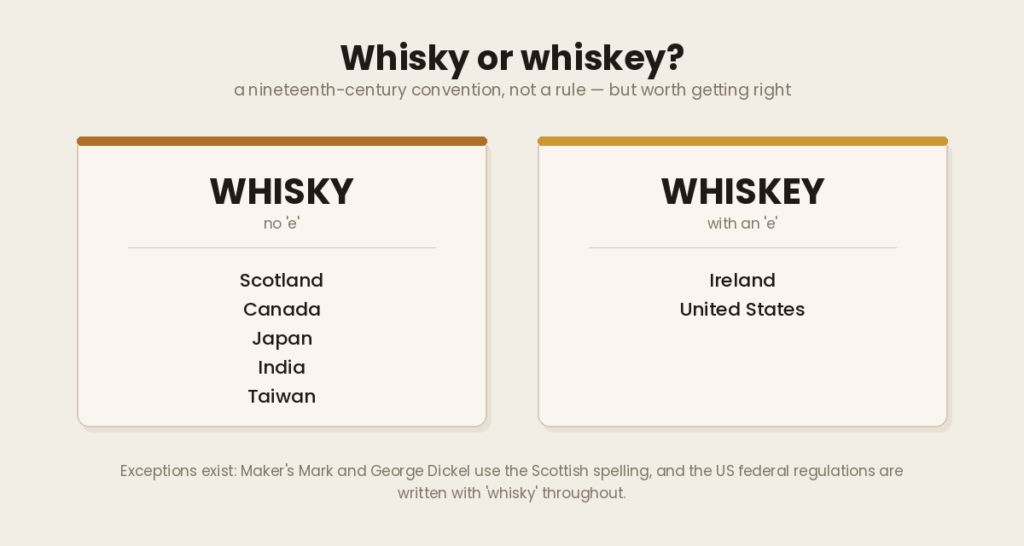
The short version: Scotland, Canada and Japan spell it whisky. Ireland and the United States generally spell it whiskey. The convention traces back to the nineteenth century, when Irish distillers wanted to distinguish their product from Scottish output at a time when Scotch had a reputation problem, and the extra “e” travelled to America with Irish immigrants.
It’s a convention, not a law, and there are well-known exceptions. Several American distilleries — Maker’s Mark and George Dickel among them — deliberately use the Scottish spelling. And in an irony that delights pedants, the US federal regulations themselves are written using “whisky” throughout.
Practical rule for writing about it: use the spelling that matches the country you’re discussing. Scotch is whisky. Bourbon is whiskey. When you’re talking about the category in general, either is defensible, though most publications pick one and stay consistent.
Why they taste so different
The legal definitions explain the mechanics. The flavour differences come from four things.
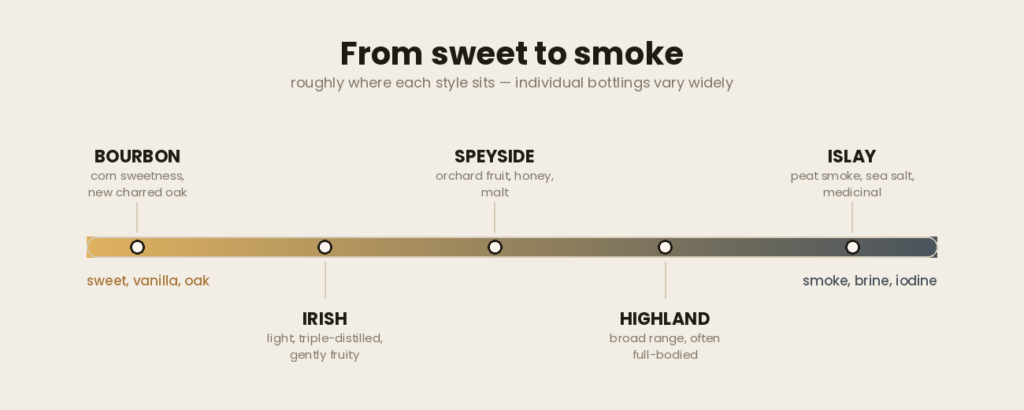
The grain. Corn is sweet and gives bourbon its round, soft body. Malted barley is maltier and more savoury, with a cereal note underneath. Rye, whether it’s the flavouring grain in a bourbon mash or the star of a rye whiskey, brings pepper and a dry, spicy bite.
The wood. This is the big one. New charred oak is aggressive — it gives up a lot, fast. A refill cask that’s already held bourbon or sherry gives up much less, much more slowly, which lets the distillery character come through instead of being buried under wood. The type of previous fill matters enormously to a Scotch’s final profile, something we’ve explored in depth in our guide to Scotch whisky cask types.
Peat, where it’s used. Scotland’s smoky whiskies get that character at the malting stage, when barley is dried over a peat fire and absorbs phenolic compounds from the smoke. It’s a regional tradition rather than a national one — plenty of Scotch has no smoke in it at all. Islay is the home of the heavily peated style, and the contrast with the softer, fruitier Speyside approach is stark enough that we gave it its own comparison.
The climate. Kentucky swings between hot summers and cold winters, which pushes spirit in and out of the wood aggressively and matures whiskey fast. Scotland’s cool, damp, stable climate does the opposite. This is why a four-year-old bourbon can taste properly mature while a four-year-old Scotch usually tastes like it needs more time — the same number on the label means very different things in different places.
Where everything else fits
Irish whiskey must be made and matured on the island of Ireland for at least three years. It’s frequently triple-distilled, which produces a lighter, smoother spirit, and it’s typically unpeated. The full comparison is in our piece on Irish whiskey versus Scotch.
Rye whiskey in the American sense follows bourbon’s rules with rye swapped in as the majority grain — at least 51% — which gives a drier, spicier result.
Tennessee whiskey meets every bourbon requirement and then adds the Lincoln County Process, filtering the new spirit through sugar maple charcoal before barrelling. Jack Daniel’s would legally qualify as bourbon; the company chooses not to use the word.
Japanese whisky was built deliberately in the Scottish image, down to the spelling and the pot stills. Its category rules are far younger than Scotland’s and were tightened only recently after years of loosely labelled imports.
Canadian whisky is often called rye out of habit, even when it contains very little rye. It’s generally light and blended, made by distilling different grains separately and combining them afterwards.
Which should you buy first?
If you’re starting from nothing, the honest answer is that it depends what you like in other drinks.
If you have a sweet tooth, or you enjoy cocktails, start with bourbon. It’s approachable neat, forgiving with ice, and it’s the backbone of an Old Fashioned. Anything from a reputable Kentucky distillery in the mid price range will do the job.
If you prefer things dry, savoury or complex, start with an unpeated Speyside or Highland single malt. Glenfiddich 12 and Glenlivet 12 exist precisely for this moment — widely available, gentle, and genuinely representative of the style.
If you’re curious about smoke, don’t jump straight into the heaviest Islay bottle you can find. A lightly peated malt is a much better introduction than something that tastes like a hospital and a campfire had an argument. Plenty of people have been put off whisky for a decade by starting at the deep end.
And if you want to explore Scotch properly rather than just buy one bottle, our beginner’s guide to Scotch whisky covers tasting technique, what to look for, and how to build a shelf without wasting money.
Common questions
Is Scotch whiskey? Yes. Scotch is whisky made in Scotland to a specific legal standard. It’s a type of whisky, not an alternative to it.
Is Scotch the same as whiskey? No — but only in the sense that a square isn’t the same as a rectangle. All Scotch is whisky; most whisky is not Scotch.
Is bourbon whisky? Yes. Bourbon is a type of American whiskey, defined by its corn content and its new charred oak barrels.
Does Scotch have to be made in Scotland? Yes, and that’s not negotiable. It must be distilled and matured in Scotland. A whisky made in Scottish style anywhere else is simply not Scotch, however good it is.
Does bourbon have to come from Kentucky? No. It has to be made in the United States. Kentucky dominates production and has its own additional rules for Kentucky-labelled bourbon, but bourbon is made in dozens of states.
Is all Scotch smoky? No. Peat smoke is a regional style, most associated with Islay. A large share of Scotch — including most Speyside malts — has no smoke at all.
What’s the difference between single malt and blended Scotch? Single malt comes from malted barley at one distillery. Blended Scotch combines malt whisky from multiple distilleries with grain whisky. Blends make up the majority of Scotch sold worldwide.
Which is stronger, Scotch or bourbon? Both have the same legal minimum of 40% ABV, and both are commonly bottled higher. Neither category is inherently stronger — cask strength bottlings exist on both sides and can exceed 60%.
The takeaway
The categories aren’t rivals and they aren’t rankings. Scotch and bourbon are two answers to the same question — what happens when you put grain spirit in oak and wait — shaped by different grains, different barrels, different weather and different law.
Knowing which is which mostly saves you from ordering something you won’t enjoy. Beyond that, the useful move is to try one of each side by side, on the same evening, with a glass of water between them. Twenty minutes of that will teach you more than any comparison table, this one included.